
Let me briefly review the Dunning-Kruger Effect: the more that you know about some topic, the less confidence you have that you have mastered that topic. Effectively, as knowledge goes up, confidence goes down. But more “fun” (and by “fun,” I mean that it better affords me the opportunity to ridicule the stupid) is that as knowledge goes down, confidence goes up.
If we were to visualize that statement as a graph, it would look something like this:
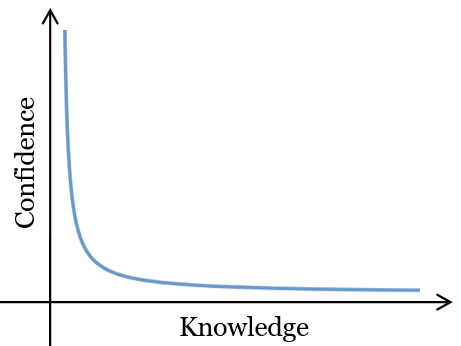
Now, that description is a bit of an over-simplification of Dunning and Kruger’s findings, but it does get the major point across fairly well.
The Dunning-Kruger Effect is actually a more nuanced, however, and a more accurate graph of this effect would look like this:
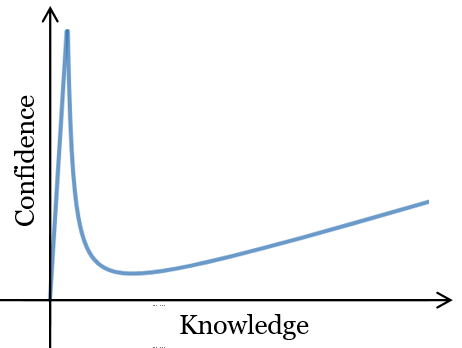
This seems to line up a bit more accurately with our educational experiences. If you recall, I opened up my last post with my stereotyped view of college undergraduates. Indeed, most freshmen do enter college with very little knowledge (of their chosen majors, that is) and very little confidence either.
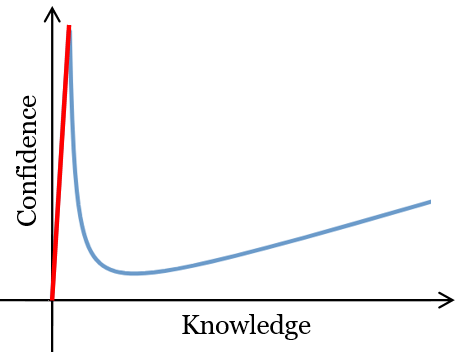
But as those freshmen proceed through those introductory courses and become sophomores, their confidence in their abilities (especially when they compare themselves to new incoming freshmen) rockets at a pace far faster than what their increased knowledge really permits. This is illustrated portion shown in red below:
Fortunately, college is a (at least) four year process, and the Junior Year comes riding in alongside its better-known accomplices of Pestilence, War, Famine, and Death.
The college junior is at once both a beautiful and terrible thing. Beautiful in that the student is now more open and receptive to his teachers than ever before. Terrible in that the student is…well…have you ever really seen a more pitiful sight than a college junior?
Just as rapidly as the early confidence rose, it evaporates. I remember that taking place in my own college career. There was a certain emptiness that crept in as I realized that, for every one thing that I learned about some topic, I was made aware of ten more things about that topic that I never even knew existed. As I learned more and more, I realized that there was much more and much more yet to learn.
But here is where people tend to misapply the Dunning-Kruger Effect. Note that as you or I learn more, “less confidence” does not mean that we know less. That idea (“knowing more” = “knowing less”) is an obvious contradiction. What it does mean is that we become less and less confident that we have genuinely mastered the entire concept.
Another misconception of the Dunning-Kruger Effect is the belief that learning more and more undermines our existing knowledge. Let me illustrate by going back to the “kindergartners learning addition” example from my last post. Imagine that the squares below indicate how much these children know about basic addition: the darker the square, the more they have learned.

These students objectively know more and more about basic addition. Even better, they can and should have more and more confidence in their ability to conduct such basic addition.
However, as they learn more and more basic addition, these kindergartners should become more and more aware of other types of arithmetic: subtraction, multiplication, division. See image below:

As their knowledge objectively increases, they become more and more aware that the mathematical “world” is far larger than just that small “world” of addition.
As students master arithmetic, they then are made aware of the larger mathematical worlds of algebra…then trigonometry…then calculus…then ad infinitum…
Thus, as one’s mathematical knowledge increases, his confidence in his mastery of “Mathematics” erodes considerably. Of course, I am grateful for the mathematics that I have had the privilege to learn and to teach, but all of that learning has made me better appreciate how much there actually is out there mathematically.
In fact, it made me finally appreciate what my high school basketball coach* told us in practice. Being high school students, we had reached peak “know it all” attitude. What could this guy actually teach us?!? One day, he had (legitimately) had enough and remarked, “I’ve forgotten more basketball than you will ever learn.” We thought that a ridiculous exaggeration.
*Yes, I “played” high school basketball. I went to a small Christian school in which try-outs consisted of checking for a steady pulse.
You know what? Having taken a lot of mathematics over the years, I now know what he meant. Indeed, I have forgotten more mathematics over the years than most of my students will even learn.* But I also appreciate the humility in which that statement can be made. My coach didn’t make that comment smugly (though I’ll admit that we needed put into our place) but rather as just a statement of fact.
*Yes, there are exceptions. One of them has earned his PhD, conducted post-doc work in England, and would easily blow me away with his knowledge. Fortunately, he’s just about the nicest guy on the planet and would just use that as an opportunity to help me grow in my own knowledge.
There is just sooooooo much out there to learn, and I save my Quiet Contempt for those who enroll at Facebook Mom University* and think they know everything.
*Sure, “The Left can’t meme,” but Church Mom is even worse.
In the next post, I plan to begin looking at the right side of the Dunning-Kruger curve and point out what its slow and steady rise means.
 Quiet Contempt