
So…in the last post, we saw this graph of the Dunning-Kruger Effect.* This week, I want to focus on the right side of the graph.
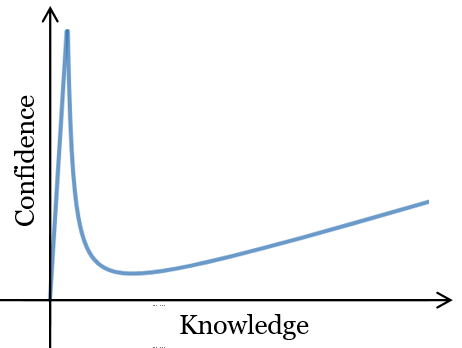
*I promise that we’re almost done with the DK Effect. I know it’s boring. I know I’M boring. But we always need to know where we really are on understanding some concept.
Malcolm Gladwell popularized the 10,000 Hour Rule in his book Outliers: The Story of Success. Gladwell makes no bones about it: this “rule” is more of a guideline than an absolute. But the principle that he promotes is that it takes about 10,000 hours of doing something to become a true expert.
Those who achieve 10,000 hours working on some concept are the ones at the extreme far right of that graph. And notice that these people have some rightfully-earned confidence in their understanding of that concept. Usually, that confidence has two aspects:
- a self-acknowledgement that they are genuinely good at that concept
- example: a twenty-year car mechanic is justifiably confident in his ability to tackle just about any mechanical issue brought to his garage
- a self-acknowledgement that there are boundaries to that concept
- example: that same mechanic understands that working on a large diesel engine (such as on a tractor-trailer) is a completely different thing
*Let me cite a personal example. My home A/C unit conked out one day, and I asked my friend to look at it. He handles immense building cooling systems that operate using chilled water technology. The first thing he said when he looked at my puny little home system was, “I’m not very familiar with these types.” The size of the system doesn’t matter; the type of technology does.
Obviously, there will be some overlap. Any car mechanic is going to be far better than me when it comes to large diesel engines simply because “car engine” and “tractor-trailer engine” both fall under the larger umbrella of “automotive mechanics.” But good mechanics in their fields are quite aware of the boundaries of their expertise.
Unfortunately, we “Average Joes” all-too-often act like “a mechanic is a mechanic is a mechanic.”
Without trying to evoke current affairs, we often act like “a doctor is a doctor is a doctor” because all (physician) doctors are somewhere under the large umbrella of “health care.” But there are huge differences from specialty to specialty. And [current affairs alert] there is a huge difference between a doctor who specializes in pharmaceuticals and a family physician who prescribes those medicines. Neither type of doctor is “more important” than the other. They are just different, and each type relies upon the other to fill in the knowledge gaps that they simply do have time to research for themselves.
But that is starting to get off topic, and I want to save what the word research means for a post all its own.
Returning to the task at hand, there is one aspect of this increased confidence that is especially important to a teacher. Now, you might say, “But I’m not a teacher.” Yes, you are.
We are all teachers.
Sure, some have teaching as a profession,* but everyone teaches at some point. You can’t be a parent without being a teacher. Even the very worst parents can’t help but teach their children something. Ask any person who was abandoned as a child, and they will tell you that their parents taught them something because of that abandonment–and usually none of it was good.
*I often tell my students this: “I am a professional teacher. That doesn’t mean that I’m any good. It just means that I get paid.”
But let’s consider professional teachers for the moment. And–humor me–I will do so by imagining everyone to be a professional teacher. This shouldn’t be that difficult. After the very least, just about all of us sat under some professional teacher at some point. We are just trying to put ourselves into their shoes for a bit.
First, ask yourself: “How did I end up teaching this material?”
The answer to that should be pretty obvious: you already had some innate talents in that area. After all, if you had no talent in that area, you’d never have developed any skills in that area. Also, keep in mind that most teachers tend to be fairly good at academics overall. So when, for example, a science teacher says, “I don’t have any talents in English,” what is usually meant is “I obviously have some talents in English; I’m just not proficient enough to teach it well.”*
*Ooo! Ooo! “Self-acknowledgement of boundaries!”
Thus, we arrive at the first application of the Dunning-Kruger Effect to teaching:
- A good teacher should be able to justifiably acknowledge his innate abilities in that subject.
But most of the students in the classroom do not share those innate abilities to the level of the teacher.
Obvious Qualifier 1: Many students do share those abilities, but they are the exceptions…not the rule.
Less Obvious Qualifier 2 (with a long explanation to go along with it…): As classes get more and more specific, the teachers also get more and more specialized. Thus, most people might consider college senior classes in mathematics to be highly specialized. Well, they are, but only relative to lower undergraduate-level (and certainly to high-school level) mathematics classes. Those who teach upper-level mathematics classes in college are usually much more specialized than the students in the classroom and have an innate talent in the specializations that the students in that room lack.
So what does this mean?
Well, let me go immediately to the second teaching application of the Dunning-Kruger Effect:
- A good chunk of the increased confidence among good teachers is mistakenly placed on the students.
Let me make this strong statement first: If a teacher thinks everyone in the class is an idiot, that’s a bad teacher.
To put it in different terms, a good teacher thinks that most of the students are capable of learning the material.* It’s just that a lot of the students have an insufficient background for immediate success: perhaps never having been taught how to truly study; perhaps lacking an adequate pre-requisite course; etc.
*It should be obvious that not everyone can learn everything. We all have different innate academic strengths and weaknesses that need identified and developed just as much as we all have different innate physical strengths and weaknesses that need identified and developed.
The issue that good teachers face is failing to recognize that the teacher’s innate abilities in the material make it appear easier to learn that material than it really is. In other words, teachers are sometimes embarrassed to teach the basics in some subject because–once that teacher first learned the concept–it looked painfully obvious in retrospect.
Now, I make no claims about being a good teacher. But let me conclude this post with a personal example.
For years, I had the privilege of teaching a beginning statistics course. The real “fun” in that course doesn’t really kick in until the end when discussing tests of significance and regression. But to get there, we had to wade through the basic topics of standard deviation and probability.
The first several years that I taught these beginning topics, I was basically embarrassed to teach them. My thinking was basically this: “These are college students. They are probably bored out of their minds with these easy items.” Indeed, they were bored out of their minds, but it wasn’t because of the ease of the material. (I’ll let you discern the reason…)
But I was subsequently puzzled at the low grades on their tests…until it finally dawned on me. There were two reasons they were getting poor grades.
- The material was tougher to them than I realized.
- I had taught it poorly because I assumed they already knew it.
I don’t claim to be genuinely good at statistics. But compared to what I do know, those beginning concepts like standard deviation and probability seem obvious.
I failed my students because, as I learned more and more, my confidence in statistics justifiably increased, but I had misplaced that confidence. I unfairly attributed to the students an ability in statistics that they just did not have.
It was doubly unfair in that their very presence in the room was a tacit admission that they were not experts in the material.
And let that be my warning to all teachers: If a student chooses (or, more likely, his parents choose for him) to honor you with his presence in your classroom, there is a silent admission from that student that he does not yet know the material. Repay that honor by assuming that he genuinely does not know that material and teach him the material; don’t just assume its obvious–because to him it is not.
 Quiet Contempt
All right, now you’re getting personal. This one is hitting a little close to home. But thanks for both eroding my confidence in teaching, and, in doing so, helping me to become a better teacher. Good thoughts.
LikeLike