The Wizard of Oz is universally considered one of the greatest films ever made:
- It is in the Top 10 on the American Film Institute’s “100 Years 100 Movies” list. Say whatever you will about the state of cinema and argue about its placement on the list (right at #10), but with the 1000s of movies made over the years, you don’t get into the Top 10 without universal acclaim.
- Yes, I know that it is based upon L. Frank Baum’s book, and that the general ideas and themes are his. But the book is much, MUCH darker than the film–the stuff of nightmares, in fact.
- Finally, I would go out of my way this week to force a movie whose central element is a windstorm: a tornado, to be precise. Why? I missed last week because Hurricane Sally decided to take a slow, leisurely stroll along the Alabama-Florida border, taking my electricity along with it. Fortunately, Sally was a fickle lady and returned my beloved electrons shortly thereafter.
But why would I reference The Wizard of Oz now when last week two weeks ago, I concluded by asking “How do you know that you can trust me for calculating a [mortgage] payment?” I think we’d all agree that the connection between the Yellow-Brick Road and the Bank of America is a bit tenuous.
Well, the connection comes from my single favorite part of The Wizard of Oz. I deliberately wrote part instead of scene in that sentence because what I love is a theme that stretches ever so subtly through the entire movie: the Scarecrow’s lack of a brain.
Throughout the film, we are clearly told time and time again that the Scarecrow has no brain. And, to be frank, Ray Bolger’s rendition of “If I Only Had a Brain” (which starts at the 2:44 mark in the video below)* is my favorite song in the film, though I’ll clearly acknowledge that “Somewhere Over the Rainbow” is an objectively better and more iconic song.
*For you “techies,” the video above clearly shows that I know how to embed a YouTube video into WordPress. I also know how to create a YouTube link that starts at a particular timestamp (in this case, it would be https://www.youtube.com/watch?v=zyhUHJKfR5Y&feature=youtu.be&t=164). What I don’t know how to do is get the embedded video to start at that timestamp. Any advice on pulling that off would be appreciated. In fact, I’ll cut your subscription rate to this blog in half!
Well, what’s so special about lacking a brain? After all, my entire career (teaching) assumes that somebody’s head is (for lack of a better term) “empty.” And frankly I can only consider myself to be successful in that career when that somebody’s head is no longer empty. To borrow Paul’s phrasing, “Though I teach with the tongues of angels, and my students have not understanding, I am as a crashing cymbal.”
But the subtle, ironic part of The Wizard of Oz‘s treatment of the Scarecrow’s lack of a brain is that the Scarecrow is always the one who comes up with the good ideas.
*And if you pay attention, the Tin Man, despite lacking a heart, is always the one who shows the most emotion. The Cowardly Lion as well always shows the most courage. After all, courage is not doing something that scares others; it is doing something that scares you. Yes, he ran away when first meeting the Wizard…but he went back later. That is courage.
And my absolute favorite moment of the movie is when the Wizard finally gives the Scarecrow his diploma (his “Doctor of Thinkology”). Why then? Because that’s the only time in the movie that the Scarecrow makes an error.*
*According to histories of the making of the film, the error was not actually intended. The Scarecrow was supposed to state the Pythagorean Theorem correctly to show off his new intelligence (or, at least, his newly recognized intelligence). In the film, he should have said, “The sum of the squares of two legs of a right triangle is equal to the square of the remaining side.” Instead, he said (with the errors in bold), “The sum of the square roots of any two sides of an isosceles triangle is equal to the square root of the remaining side.” But I’d argue that this error on the part of the filmmakers drives home the point much more strongly than it would have been otherwise.
So…what’s the point? Credentials aren’t everything.
Now, let me first put out a “Stupid Alert.” Do not interpret the statement above as me saying, “Credentials mean nothing.” And certainly do not tell others that I think that “credentials mean nothing.” Because, if you do, then you, my friend, are stupid. No, let me tweak that: you, my friend, are STOO-PID.
I would love to get into the meaning of “Credentials aren’t everything” this week, but I feel that I just need to first address the abundance of stupid that is everywhere.
And for that, I need to talk about negation. To negate a statement is to simply change what we call its truth value. The statement, “The Eiffel Tower is in Paris” is either true or it is false. And, clearly, that statement is true.
To change the statement to false, we simply introduce the word not as needed: “The Eiffel Tower is not in Paris.” Simple enough, no?
It gets a little trickier when there are a bunch of things involved, such as the entire population of France.
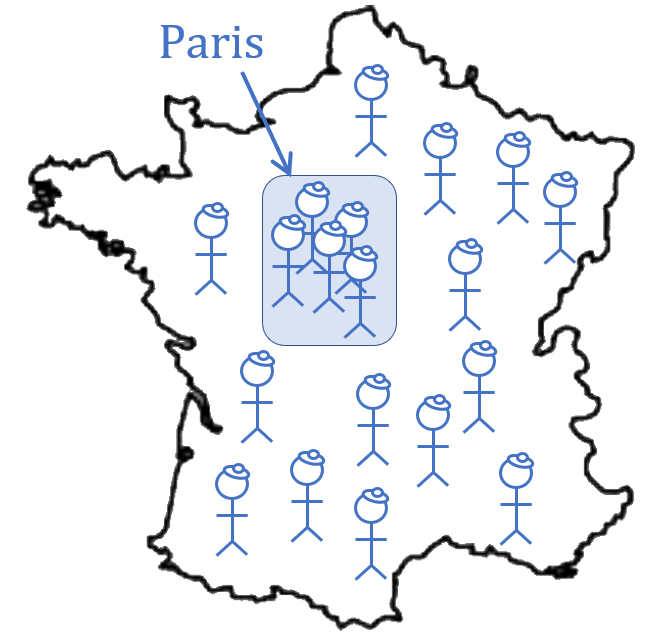
Consider this: “Every Frenchman is in Paris.” That statement is clearly false–just ask a citizen of Marseille or Toulouse.
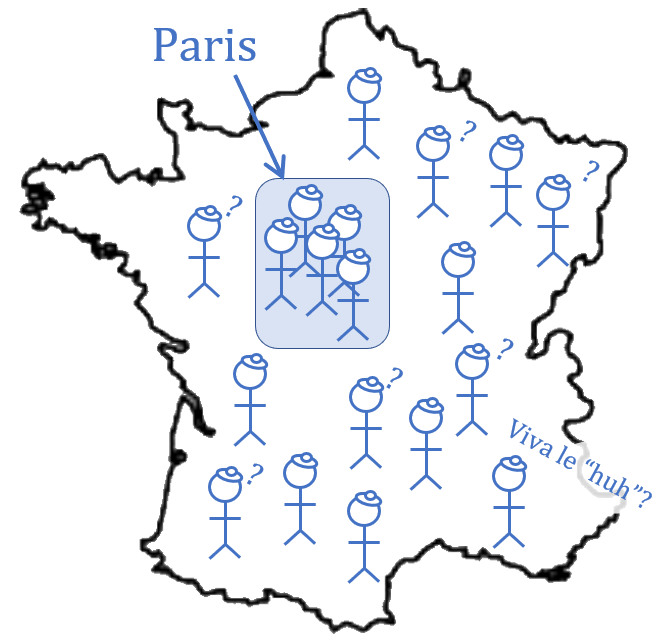
But creating the negation is a little more difficult this time. After all, the statement, “Every Frenchman is not in Paris” is still false (now ask a Parisian).
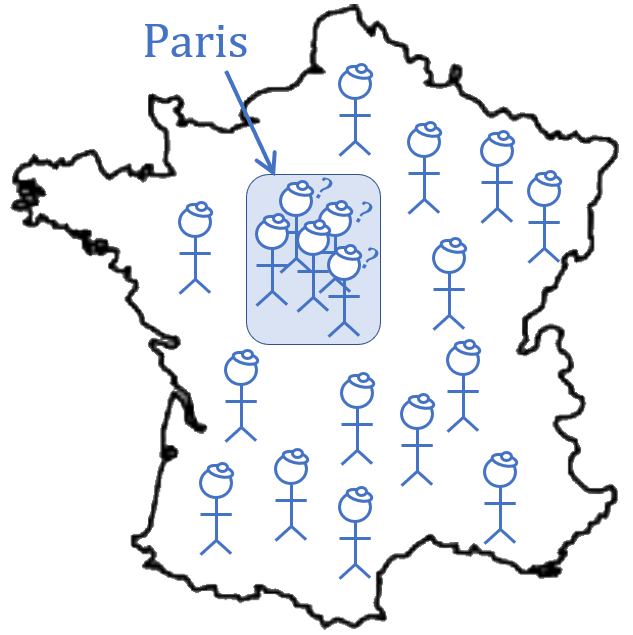
The negation of “Every Frenchman is in Paris” is actually “Not every Frenchman is in Paris.”
In other words, the negation of all is not none. There is some middle ground.
Well, my statement “Credentials aren’t everything” is a negation: “Credentials are not everything.” What is it negating? The simple statement, “Credentials are everything.”
Thus, “Credentials aren’t everything” leaves room for “Credentials still mean something.”
But what do they mean?
 Quiet Contempt