
So last week’s blog began a series of posts dealing with certainty and ended on a cliffhanger*: Is mathematics certain?
*OK, considering most of you fell asleep before the end of that post, cliffhanger might be a tad strong.
Frankly, that’s a pretty stupid question.
Now, some would remark, “Of course, it’s a stupid question. Mathematics is certain.”
Congratulations…you’re as stupid as that question.
“What?!? You’re saying mathematics is not certain?!?”
Additional congratulations on plumbing even further depths of stupid because I’m not saying that either.
I’m not saying it’s a stupid question because the answer is obvious. I’m saying that it’s a stupid question because it creates a false dilemma. It forces a “yes” or “no” answer to a question that cannot be answered either way.
“OK, heretic! I’m done with your blog!”

OK, now that we’ve gotten rid of the morons who proved the Dunning-Kruger Effect far better than I ever could, we can get down to business.
As I’ve made quite clear so far, “Is mathematics certain?” is a pretty stupid question. Yes, I’ll admit that it seems harmless enough. After all, isn’t mathematics certain?
Well…MOAR MEMES!!!!
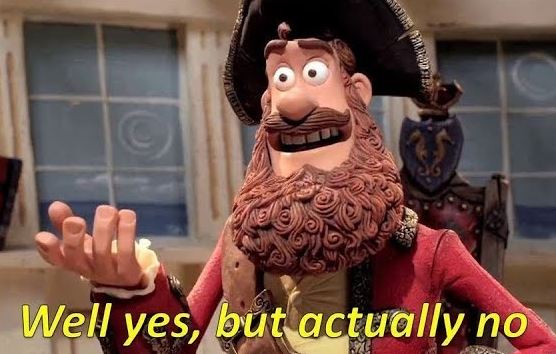
What I mean by all of this is that some things in mathematics are certain but some are not.
Let’s start with the most basic of all: “Is 2 + 2 = 4?”
Yes, assuming the integers under normal arithmetic.
“Well, how could it possibly be anything else?”*
*”Paging Drs. Dunning and Kruger. Paging Drs. Dunning and Kruger.”
Let’s consider a couple of examples where 2 + 2 is not 4.
The first comes from…uh…chemistry? physics? chemysics? My hesitation stems from the fact that the chemistry involved in this example is explained by the physical properties of the chemicals. Let’s just say it comes from…SCIENCE! (insert dramatic theme music here)
Anyway, let’s grab two gallons of water and (going full-on Russian) two gallons of alcohol*–say, ethyl alcohol specifically.
*Anytime you need to explain a joke, that joke fails. So let me acknowledge that joke in my title probably failed because it actually references this right here. Russians love their alcohol–especially vodka, which is brewed from potatoes. Get it? GET IT?!? “potato soup” “vodka” HAHAHAHAHA…huh?…what’s that? Yes, I’ll shut up now and get back to the post.
What happens when you mix together the two gallons of water and the two gallons of alcohol? You get approximately 3.84 gallons of solution. As tempting as it is to blame Vladimir for sipping that extra 0.16 gallons of alcohol,* the fact is that the only correct way to do the arithmetic here is to accept that 2 + 2 ≈ 3.84.
*That translates to about 2 1/2 cups of pure alcohol. Good night, Vladimir! Do svidaniya, Vladimir’s liver!
That’s why the stipulation above (“assuming the integers under normal arithmetic”) is so critical. And that’s why units are so important in the above example. The statements “2 + 2 = 4” and “(2 gal. water) + (2 gal. alcohol) = (3.84 gal. solution)” are very different things.
So my typical answer to “Is 2 + 2 = 4?” is usually, “Under normal arithmetic? Well, then, obviously ‘Yes.'”
I don’t do this to play semantic games or to try to appear smarter than someone else. I just find it good practice to make sure that we’re all speaking on the same terms.
Jesus would occasionally employ the same tactic. In Matthew 19:16, someone asks Jesus, “Good Master, what good thing shall I do, that I may have eternal life?” This is every witnessing Christian’s dream. Instead of knocking on door after door time and time again,* someone just walks up and asks how to be saved!**
*And having those doors forcefully knock back on noses time and time again.
**Of course, the answer is not in a “good thing to do,” but at least the conversation is off and running.
In a very interesting twist, Jesus throws the question right back at the questioner, “Why callest thou me good? there is none good but one, that is, God” (v. 17).
In other words, before we can talk about the “good things” you must do, what do you even mean by good in the first place? If there is none good but God, then how can the things you do–beneficial though they may be–really measure up to this Ultimate Standard of good?
Jesus is clarifying (for the benefit of the questioner and the surrounding audience) that good in this context means “gaining God’s complete approval” instead of the typical use of good to mean “a preferential outcome.”
Similarly, I like to establish the boundaries of some conversation just as that conversation gets underway–not for some “holier-than-thou Jesus-did-it-now-watch-me-do-the-same” reason, but usually because I’m just pedantic.
Another way in which 2 + 2 could differ from 4 would be using modular arithmetic. I certainly do not want to get into a deep discussion here, but let me mention that we all use modular arithmetic on a daily basis. And I mean literally a “daily basis.”
Why? Because of the clocks on which we base our days. Ignoring military time,* what is 8 o’clock plus 6 hours?**
*For those of you who’d like to out-pedant me. I know your little game…
**Again…no cheating! I already told you that “14 hundred” is off limits. And, yes, I also know that every sergeant every where and at every time pronounces it as “14 hunert.”
The answer is clearly 2:00. In the context of “clock arithmetic,” 8 + 6 = 2.*
*And for you stubborn military time adherents, I ask you, “What is 8 ‘hunert’ plus 20 hours?”
“Clock arithmetic” uses what is called “modular 12 arithmetic” or “mod-12.” Basically, 12 counts as 0. We write this as 12 ≡ 0 (mod 12).*
*[Technical nerd info. follows. Continue at your own peril.] The ≡ symbol is not a mistake. It indicates “congruent to” or “equivalent to.” Addition in modular arithmetic is technically the combination of classes (or collections) of numbers. Every multiple of 12 (…, -24, -12, 0, 12, 24, 36, …) is part of the same “class” as the number 0. But keep in mind that this is still addition; though the “=” sign might be replaced with the “≡” sign, the addition sign “+” remains the same.
In “clock time” (or “mod 12”), the numbers go as follows: 0, 1, 2, 3, 4, 5, 6, 7, 8, 9, 10, 11, 0, 1, 2, 3, 4, 5, 6, 7, 8, 9, 10, 11, 0, 1, 2, etc.* (Remember that 12 and 0 are the same thing in this context.)
*Please note that once I successfully take over the world, I will replace all the 12’s at the top of each clock with a 0. You might not like it initially, but I’m doing this for your own good. You’re welcome.
In terms of arithmetic, every integer can be converted to a number between 0 and 11 (remember that 12 means the same thing as 0) by dividing that number by 12 and looking only at the remainder.
For example, consider 38. Well, 38 ÷ 12 = 3 remainder 2. Thus, 38 ≡ 2 (mod 12). What does this mean? Suppose it is 7:00 right now. Then you can calculate the time 38 hours from now by just adding 2, giving 9:00.
Obviously, 7:00 a.m. today would convert to 9:00 p.m. tomorrow night. Similarly, 7:00 p.m. tonight would convert to 9:00 a.m. the day after tomorrow. Such details might matter immensely to you, but the clock doesn’t care. It doesn’t care about your days or nights; it doesn’t care about the day of the week, month, or year. It’s a clock, for cryin’ out loud.
If you think about it (and I hope this blog makes you do that…), that’s more-or-less how we do this calculation anyway. If adding 38 hours, we basically “throw away” all the 12-hour increments as irrelevant. We “throw out” the first 12 hours, giving 38 – 12 = 26. Theoretically, we’d continue throwing hours away as follows:
- 38 – 12 = 26 (26 is “too big” for the clock)
- 26 – 12 = 14 (still too big)
- 14 – 12 = 2…Aha! 38 hours from now is essentially just two hours on the clock!
- 7:00 + 2 hours = 9:00…Eureka!*
*For the record, I strongly suggest that your “Eureka!” reaction be less…uh…”memorable” than Archimedes’ (in)famous “Eureka!” moment.
What about 38 hours after 11:00? Well, “38 hours” still converts to “2 hours” on the clock. 11:00 + 2 hours = 13:00 (“Ahhh!…’too big’…”), but “13:00” you know to just be one hour past 12, ergo, 1:00.
This just scratches the surface of modular arithmetic, and–who knows?–maybe sometime in the future, I’ll cover it more in depth.*
*Note that virtually all internet security is based upon using modular arithmetic of REALLY big numbers; look us “RSA encryption” if you are so inclined. The point here is that the topic of modular arithmetic is a LOT more than just the trivial situation of figuring out times.
But the current discussion is focused more on “2 + 2 = 4,” so let’s return to that.
Obviously, in “clock time” (“mod 12”) the numbers 2 and 4 never get near the number 12 that causes things to reset to 0.
But what about “mod 3”? Here, the number 3 is the same thing as 0. Thus, the numbers cycle back even more quickly than on a clock: 0, 1, 2, 0, 1, 2, 0, 1, etc.
In the case of “mod 3” arithmetic, 2 + 2 = 1. “HUH?!?” Well, 4 = 3 + 1, but 3 and 0 are the same. Thus, 4 = 1.*
*[More technical info.] Technically (that’s what “technical info.” means, I guess…), 4 ≡ 1 (mod 3), and technically 2 + 2 ≡ 1 (mod 3).
Now, to appease the Salem jurors accusing me of witchcraft, I’m gonna try to have my cake and eat it, too.* Notice that in these two examples–(a) mixing water and alcohol and (b) addition modulus 3–there is still complete certainty as to the final answer.
*I’m still trying to fit three completely unrelated metaphors into one sentence, but–so far, even in my best attempts–I’ve only been able to fit two.
The “uncertainty in mathematics” I’ve been alluding to arises in these cases only from failing to establish the context of the arithmetic.
- In the context of the integers under normal arithmetic, 2 + 2 is certainly 4.
- In the context of addition modulus 3, 2 + 2 is certainly 1.
- In the context of adding water and alcohol, 2 + 2 is certainly 3.84 (within rounding)
Wait…WHAT? “Within rounding?”
Yup, “within rounding.” And this is where the genuine certainty that we “know” and love from mathematics begins to be distinguished from the genuine uncertainty when using mathematics. But that’s for next week.
For now, let me leave you with this question as an appetizer:
- How many tons do you have when you put two 14-ton dump trucks on the same scale?
 Quiet Contempt