
“When you come to a fork in the road…take it.”
Yogi Berra
It is unfortunate that the great Yogi Berra is better remembered for his humorous quotes than for his Hall-of-Fame playing (and coaching) career: 18 All-Star Game appearances, 10 (!) World Series championships, caught Don Larson’s perfect game (dominating the video of the final out as the jubilant catcher leaping from home plate and bounding into Larson’s arms), and so on.*
*As a Pittsburgh Pirates fan, he even shows up in the Pirates’ greatest moment as the left fielder (!) looking up dejectedly as Bill Mazeroski’s home run won the 1960 World Series.
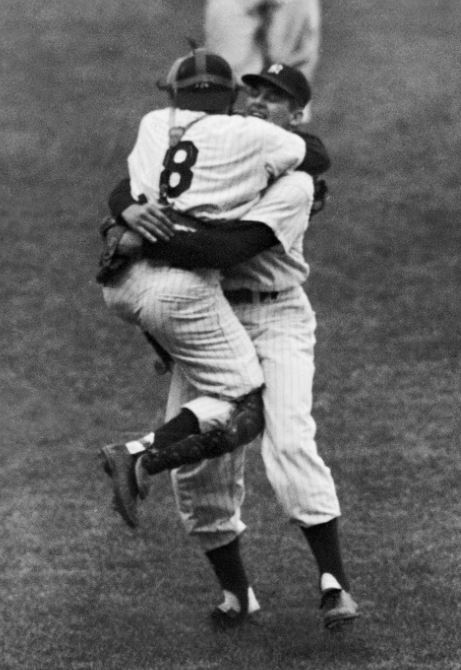
But the ability of his quotes to outshine such a career only illustrates just how brilliantly charming–yet surprisingly introspective–they really were:
- “It ain’t over ’til it’s over.”
- “Nobody goes there anymore. It’s too crowded.”
- “A nickel ain’t worth a dime anymore.”
The point is this: I came to a fork and failed to take it. Way back when I was actually writing this blog, I was working through a definition of proof: an argument that convinces qualified judges.
I worked through the meaning of argument.
I worked through the meaning of convinces.
Then the “fork”: continue through the meaning of qualified (as started in my previous post) or work through the meaning of judge? I successfully chose neither.
I sat on it for a while, but “a while” soon became “a month.” “A month” soon became “a few months.” I’m now trying to keep “a few months” from growing into “many months” or “a year” or “several years” or–most likely–“six weeks past Rapture.”
Sooooo…let’s just go with the meaning of judge.
Having made this choice, I now realize just how easy this part is. The much tougher part is going to be returning to the meaning of qualified.
My problem, though, is that I suffer from the same issue that I expect you suffer from: I have a hard time distinguishing between judge and qualified judge.
It turns out that anyone can be a judge. In fact, everyone is a judge.
“But the Bible says, ‘Judge not’!” O, ye of little brains. Have ye not read? The rest of the verse (Matthew 7:1 and the subsequent verse 2) continues “that ye be not judged. For with what judgment ye judge, ye shall be judged.”
Simply put, a judge is “one who makes a decision.” As a verb, judge means “to reach a conclusion.” And Scripture’s warning in Matthew 7 is basically a rewording of the Golden Rule: “Judge others as you would have them judge you.”
The more I think about it, the better this warning makes sense in light of the proof definition. Think about it: this whole blog (four-month absence and all) has basically been me making claims about how we can know things. This started with some posts on the Dunning-Kruger Effect (the idea that the more we learn about some topic, the less confident we are that we have mastered it).
Every claim made about the Dunning-Kruger Effect was essentially me passing some judgment about it. Consider, for instance, that there are only two possibilities about the Dunning-Kruger Effect: (a) the effect is real or (b) the effect is NOT real.
I made a decision here. I–hold on to your biblical hats–made a judgment here: I deemed the Dunning-Kruger Effect to be real.*
*Keep in mind that determining “how accurately” it describes the relationship between knowledge and confidence is an entirely different question from determining IF there is a relationship at all.
I don’t claim to speak for God, but I really doubt that He’s about to split the sky open and vaporize me with a bolt of lightning for having made this judgment.*
*My kids and especially my wife can testify that I’ve done a LOT more to warrant the Holy Bolt of Disciplinary Lightning (level 4).
But what I have done is put myself into a position to be judged in turn by others–in particular, by those with an understanding of the Dunning-Kruger Effect. And I’m certainly in a position to be judged by those who understand the Effect more deeply than do I.
There’s even a small part of me that somewhat wants Dunning and Kruger themselves to read those first few posts of mine so that they could correct my own misunderstandings of the concept.
There are several ways to describe how well someone knows material, and one of the most common is Bloom’s Taxonomy of Educational Objectives (where taxonomy simply means “classification”).
Bloom’s Taxonomy has undergone several revisions over the years, but one of the highest levels of learning is Evaluation. Evaluation literally means “to evaluate” or…wait for it…”to judge.”
*Evaluation was actually the highest level in the original formulation of Bloom’s Taxonomy.
Thus, in a weird sort of way, I made a judgment way back when about the Dunning-Kruger Effect partly to introduce others to the concept. But there was a small, private reason as well: once I put my ideas out into the vast wasteland of the internet, I have put myself in a position for others to, in turn, critique (or judge) my own observations.
If my observations–if my judgments–can bear the critique of others, I am in that much better of a position to promote those observations as genuinely correct.
The real issue with judging, however, is in being qualified. Any idiot can criticize, but most of those criticisms are just the stupid mutterings of the ignorant.
The judgments I welcome as a retort to my own judgments are those from qualified judges–not the “expert opinions” of “YouTube researchers” or graduates of the “University of Facebook Moms” who’ve “uncovered the vast Illuminati-based conspiracy to use Amazon Echoes to ultrasonically inject us with Martian vaccines.”*
*No, I’ve not seen this specific claim anywhere And, yes, I’m making it up now, hoping that some idiot will read it and think “Maybe he’s onto something…”
But I’ve struggled a bit in my writings about qualified, allowing that struggle to grind this blog to a halt for these last several months.
Thus, I’m going to move on for the time being. Once I finally figure out what I want to say about qualified, I’ll return to it, and formally close the discussion of proof.
For now, just keep in mind that whenever I use the word proof, I use the following definition: an argument that convinces qualified judges.
And I’ll be sure to be back in just a few short months…


This is deep.Ben. Thanks for your thoughts.
LikeLike